Categories
News Portugal

10 GOOD REASONS TO RETIRE IN PORTUGAL

Based on the article by Marc Martin – Portugal https://www.lisbob.net/en/blog/retire-portugal-10-good-reasons

Portugal is attracting more and more foreign pensioners who decide to live happy days away from their country of origin. Also, many Portuguese or Luso-descendants who return to their country to retire there. Although each decision has its own reasons, Portugal benefits from several assets that make the country a landmark destination for retirement. Cost of living, security, weather, each retiree will have his own reasons for having decided to retire in Portugal. In order to help you in your decision and remaining as objective as possible, we have listed for you the best reasons to live your retirement in Portugal. Lisbob, the expatriate assistant in Portugal, tells you all about the 10 good reasons to retire in Portugal.

Portugal is attracting more and more foreign pensioners who decide to live happy days away from their country of origin. Also, many Portuguese or Luso-descendants who return to their country to retire there. Although each decision has its own reasons, Portugal benefits from several assets that make the country a landmark destination for retirement. Cost of living, security, weather, each retiree will have his own reasons for having decided to retire in Portugal. In order to help you in your decision and remaining as objective as possible, we have listed for you the best reasons to live your retirement in Portugal. Lisbob, the expatriate assistant in Portugal, tells you all about the 10 good reasons to retire in Portugal.

1. Weather

Portugal enjoys a mostly sunny and rather mild weather in winter. Nevertheless, do not believe on the word the ominous birds who promise you 320 days of suns a year and winters at 20 degrees. It will already depend on where you live. The north is rainy and wet, the Algarve rather hot and dry. Nevertheless, this is where Portugal’s strength lies: the diversity of climates and landscapes that the country offers. Of course, winter in Porto will be less rigorous than Charleville-Mezieres, but it will take into account the insulation of housing. Be that as it may, the weather is an essential criterion when choosing your expatriation and Portugal allows any retiree to choose the place where he will feel the best.

2. Safety

This is one of the most important criteria when choosing your country of expatriation to retire, the feeling of security. And on this point, we can say that Portugal is part of the world top in terms of living together and security. Indeed, the country is often cited in the rankings of countries where it is good to live in terms of security. Any expatriate in Portugal will tell you: it is rare to see an aggression and even less to be attacked. Women can walk quietly in the street without worry and assaults are rare. Of course, we must be careful as everywhere else, but Portugal is a country where life is good and where “dangerous” places are less present than in other countries.

3. Cost of Life

Portugal is a country with a cost of living that is lower than in other countries like France or Germany. The foreigners who come to Lisbon will be pleasantly surprised to pay their coffee 50 cents on the terrace of a European capital, or even to have lunch for less than 10 euros with full menu. In addition, some products such as tobacco or alcohol are cheaper. Be careful however, the cost of living in Portugal is sometimes much higher than in other European countries for some products. For example, hygiene or household products cost almost twice as much (!) as in UK for example, and electronic products and appliances, such as mobile phones or computers, cost on average 15 to 20% more expensive. The reasons: a 23% VAT and a geographical position at the far end of the continent, implying higher transport costs for imported products. Each retiree will have to take stock of these expenses and see if his lifestyle allows him to live better with so much.

4 Hospitality

The Portuguese are known and well-known for warmly welcoming foreigners who decide to settle there. One of the reasons for this is surely the millennial history of the Portuguese, people of explorers and emigrants who settled in the four corners of the world. The Portuguese know how to integrate as well as to welcome other retirees from all over the world. All you have to do is ask for directions, even if you speak a beginner Portuguese, and you will see how warmly and kindly the Portuguese will try to help you. Unfortunately, the flip side is that there is sometimes a bad intention behind all these nice touches. Of course, we do not put everyone in the same basket, far from it, but it would be a lie to say that all Portuguese are nice by good intention. Many are the scams and traps for strangers who, a little naive and gullible (we have all been), are having to think that everything is pink. No, buying real estate, cars or even simple jobs can turn into a well-crafted scam without any recourse.

5. Landscapes

When you look at Portugal for the first time, you are surprised by the diversity that this relatively small country offers. Indeed, Portugal, 6 times smaller than France, is full of landscapes and regions all different and interesting from each other. For pensioners, Portugal is simply an inexhaustible source of landscapes all more beautiful than the others. The northern, more humid and mountainous, offers green natural parks and exceptional views, as in Geres. The Douro Valley, world heritage, allows you to admire the vines carved for centuries and the valleys shaped by the Portuguese. The Algarve, known for its beautiful and wild beaches, will delight lovers of sunsets, while the Serra da Estrella massif will allow you to ski on natural snow.

6. Culture

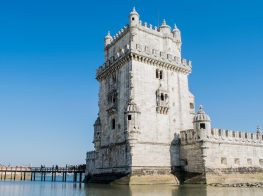
Portugal is a country full of cultural activities, some of which are world famous. As a retiree, the cultural offer is one of the criteria to be taken into account. Museums, galleries, festivals, concerts: Portugal has a rich and diverse culture, fruit of its influences from all over the world and its past made of discoveries but also bad times. Fado is the most accomplished expression, but the style may not please. Nevertheless, in the 21st century Portugal has developed its offer and showcased its cultural heritage. The neighborhood of Belém in Lisbon offers many museums and monuments to visit, and the cultural agenda is full throughout the year. When you retire in Portugal, you will not be bored.

7. Food and Gastronomy

Eating well is important, and even if tastes and colors are not discussed, Portuguese cuisine is known to be hearty and quality. Fresh vegetables and local, rice pushed in Alentejo, fish galore, many are the assets of the gastronomy of Portugal. If you take the time to spend your retirement, you will have plenty of time to discover the incredible amount of dishes that make up the Portuguese cuisine. Also, Portugal has imported and adapted dishes and ingredients from its ancient conquests from different continents: African, Asian or South American cuisine invites itself to Portuguese dishes for our greatest pleasure. It should be noted that the Portuguese have a habit of eating rather fat, and they do not skimp on the amount of oil.

8. Health

The Portuguese are known to have a good life expectancy, and retired foreigners who decide to spend their retirement know it well. This is due in particular to the fact that their diet is recognized as good for the health, but also thanks to the Portuguese health system. In fact, Portugal’s doctors and medical specialists are among the best trained and most professional in Europe. Universities where future doctors and surgeons are studying are famous all over the world. To put it simply, do not worry about the quality of the health professionals you will find in Portugal. Nevertheless, the Portuguese public health system is in very bad shape. The crisis has gone by, and the fact that it is almost entirely free means that available resources are limited. A situation that is deteriorating little by little, pushing users to turn to the private sector.

9. Real Estate

Even if the “golden age” of cheap real estate anywhere in Portugal is over, it would be lying to say that Portugal does not yet offer fantastic real estate opportunities. In fact, Portuguese property prices remain on average lower compared to other European countries. Lisbon and Porto may now be at levels of other European capitals, but Portugal is big and offers many beautiful places and unbeatable prices. Any pensioner will find his happiness, even more if he wants to get away from tourist areas. A big flat, though. With the popularity of recent years, many are the real estate agents who have started to flourish in Portugal, and not often the most honest. If you do not master the Portuguese language and its subtleties in terms of the law, we strongly advise you to be accompanied by a lawyer or a notary. Also, going through a known and reputable agency can be a guarantee of quality. You can go through our free real estate search service to help you.

10. Tax System

This last point will not please everyone. Portugal, since 2012, proposes a tax status called NHR for non-habitual resident. This status allows under certain conditions to obtain a total exemption from taxation on private pension income for a period of 10 years. Yes, a decade without IRS. So of course, this only concerns private sector pensions, and you should not have been resident in Portugal for the 5 years preceding the application for the famous NHR status. Nevertheless, this tax boost is often the icing on the cake, the reason that tipped the decision to retire in Portugal. Be careful, however, because the NHR status should not be or become the sole reason that drives you to live your retirement in Portugal, because you could be disappointed. Portugal is much more than a simple tax exemption on its pensions, and many are expatriates who have left Portugal because they are dissatisfied with other points. While this status is advantageous for pensioners who decide to settle there, it should not be forgotten that this measure remains marginal (less than 30,000 beneficiaries over 10 years) and is not very well received by Portuguese retirees.

Based on the article by Marc Martin – Portugal https://www.lisbob.net/en/blog/retire-portugal-10-good-reasons
Categories
Cascais Portugal

Cascais, Portugal – A Fishing Town, Charming and Traditional

Cascais, Portugal – A Fishing Town Charming and Traditional

Along the northern side of the Tejo Estuary is the Linha de Cascais, an urban railway that takes you from Lisbon to the little fishing town of Cascais. The train departs from the Cais do Sodre train station in Lisbon and ends its short but delightfully scenic journey along the River Tagus, at Cascais station. The quickest and easiest method of travel from Lisbon is by train, particularly as the station in Cascais is located in the centre of town. Travel by car is easy but parking is limited. You also have the option of a somewhat slower bus-ride from Lisbon, but the bus terminal is not as conveniently situated as the station.

A notable landmark in Cascais is the Cidadela, a fortress built in the 15th century to defend the town against Spanish invaders. Four hundred years later, King Louís I of the ruling House of Braganza visited this little fishing retreat, renovated the fortress and took up summer residence there. From then on, Cascais became one of the most sought-after and cosmopolitan holiday places in Portugal.

Elegant villas with splendid views over the bay grace the coastline and fascinating museums face onto intricately cobbled streets. Cascais offers world-class hotels, delightful restaurants, and lively nightlife, all with the traditional Portuguese touch. However, Cascais is still a fishing village. Fishermen push their boats off the beaches at sunrise and return with their catch of dorado, róbalo, sardines, octopus, crabs, and mussels; after which they gather hospitably around tables on the dock for a lunch of local wine, fresh bread, and fish soup served from enormous pots.

The town is charmingly set among the beaches of the Portuguese Riviera, from the relaxing swimming beaches of Cascais itself to the wide surfing beaches set against the dramatic natural scenery of the untamed Serra de Sintra in the north.Day trips are available to Ericeira, Praia das Maçãs, and Sintra. Midway between Cascais and Sintra lies the rugged wind-swept headland of the Cabo de Roca. A lighthouse, cafe, and gift shop are the simple marks of civilisation in this wind-scoured meeting of land and surf. Mainland Europe terminates at the point where these wild cliffs jut out into the sea.For those of us who prefer to avoid the well-trodden tourists haunts there are hiking trails following ancient paths along the cliff-tops. These lead to coves with unsullied beaches such as the Praia da Ursa or Praia da Adraga.Cascais has a wonderful, moderate climate all year round with temperatures from 12 C to 25 C. Favorable sun and wind conditions make sailing, surfing, kite surfing, and windsurfing popular tourist activities in this region.

The Golden Visa program offers you much more than a brief holiday in this stunning area. Investing in property in Cascais and other parts of Portugal allows you a European Residence Permit Card and a Passport (Portugal) giving you the ability to live and travel all over Europe. Not only this but having an investor visa entitles you to live, travel, work or study in 26 EU Schengen Space countries. It is undoubtedly the opportunity of a lifetime.

cobble street

Lisbon’s property market shows signs of positive response to the COVID crisis.

trams

In this post we explore the outstanding potential of Prata Riverside Village, combining waterfront tranquility with urban convenience.

lagoon

Based on the article Why Portugal is too hot for some by Henrique Almeida for Bloomberg Portugal is sticking with its golden visa program even though locals are being squeezed. Ana Guerreiro points across the street at a handful of housing projects in Lisbon’s up-and-coming riverside neighborhood of Marvila. It’s where she moved in with her mother last year […]

Categories
News Portugal Real Estate Investment Portugal Uncategorised

Real Estate Investment in Portugal – a Global Citizenship Opportunity

Real Estate Investment in Portugal a Global Citizenship Opportunity

MYGRATE INVESTMENTS

Portugal’s beauty and sense of history, its traditions and lifestyle make it an obvious choice for an amazing and truly memorable holiday destination. But have you, as a South African, ever considered the advantage Portugal offers as an investment prospect? The Golden Visa programme opens up a panorama of exciting opportunities to those who have a thirst for a total change of lifestyle.


Lifestyle Choices

Portugal offers, with investment in real estate, the prospect of a complete change of lifestyle in a country that is fascinating, steeped in history, stylish, incredibly scenic, and welcoming. Property has always been a safe long-term asset but property investment in Portugal may be the most valuable investment choice you will ever make. 

Residency in Portugal

European residency through the Golden Visa Permit is a safeguard against future instability, ensuring access to education, travel, quality healthcare, and tax freedom.

Global Citizenship

As citizenship through investment, the Golden Visa provides open access to nine countries across Europe and the Caribbean. This Global Citizenship program is a massive asset to any international investor, offering freedom of movement and tax advantages.

Mygrate’s team will guide you through the process according to your situation and lifestyle choice, ensuring you and your family have all the information needed. We will assist you in the purchase of property and ensure that you avoid the pitfalls. We are also here to offer peronalised investment advice, aid with tax-planning, to offer statistical data on property transactions, and provide you with every opportunity to make well-informed investment decisions.

Open the door to visa-free travel

to over 170 countries.

Start your journey to EU citizenship today!

!function(){function t(t){this.element=t,this.animationId,this.start=null,this.init()}if(!window.requestAnimationFrame){var i=null;window.requestAnimationFrame=function(t,n){var e=(new Date).getTime();i||(i=e);var a=Math.max(0,16-(e-i)),o=window.setTimeout(function(){t(e+a)},a);return i=e+a,o}}t.prototype.init=function(){var t=this;this.animationId=window.requestAnimationFrame(t.triggerAnimation.bind(t))},t.prototype.reset=function(){var t=this;window.cancelAnimationFrame(t.animationId)},t.prototype.triggerAnimation=function(t){var i=this;this.start||(this.start=t);var n=t-this.start;504>n||(this.start=this.start+504),this.element.setAttribute(“transform”,”rotate(“+Math.min(n/1.4,360)+” 12 12)”);if(document.documentElement.contains(this.element))window.requestAnimationFrame(i.triggerAnimation.bind(i))};var n=document.getElementsByClassName(“nc-loop_circle-02-24”),e=[];if(n)for(var a=0;n.length>a;a++)!function(i){e.push(new t(n[i]))}(a);document.addEventListener(“visibilitychange”,function(){“hidden”==document.visibilityState?e.forEach(function(t){t.reset()}):e.forEach(function(t){t.init()})})}();

Categories
News Non Habitual Residence Tax Portugal Real Estate Investment Portugal

Benefits and Opportunities under Portugal’s Golden Visa

Explore the Benefits and

Opportunities

Offered by Portugal’s Golden Visa

Portugal offers a host of benefits under the Golden Visa regime, not least EU citizenship, which opens up a vast number of opportunities for study and travel, both for you and your family.

As a retirement option, Portugal offers a welcoming atmosphere to ex-pats, excellent tax benefits, prime health-care, and opportunities for travel. The Golden Visa is also an uncomplicated, flexible and speedy way of gaining Portuguese citizenship and a stepping stone into other Schengen countries. It is hands-down the best option for Golden Visa investment.

Invest a minimum of EUR 350,000 in a Portuguese Investment fund

over a period of 5 years.


Advantages

Member of the Schengen Area and the EU

Right to live, work and study in Portugal

Pathways to obtaining Permanent Residency and Citizenship in Portugal after 6 years

And Other Benefits

High standard of education and healthcare

Visa-free travel within the Schengen Countries

Short physical residency requirement

No language, education or management requirements

Dependents

  • Spouse
  • Dependent children under 26 as long as they are single and enrolled as full-time students.
  • Parents of either spouse if over 66 years oldor 55 and dependent.

Portugal’s Golden Visa scheme is a five-year residency-by-investment program designed for non-EU nationals. If the investment is held for at least five years, permanent residency or citizenship is possible. The Golden Visa opens a number of doors to qualifying investors and their family members giving them the right to live, work and study in Portugal while also permitting free movement in Europe’s Schengen area.

Golden Visa requirements for Portugal

In order to qualify for the program, you need to meet the following requirements:

Be either non-EU, non-Swiss, or non-EEA.

Make a minimum investment of €350,000.

Have a clean criminal record.

Spend a minimum of seven days in Portugal for the first year, then no less than 14 days each subsequent two-year period.

Golden Visa Opportunities and Benefits

Portugal has become especially desirable to foreign investors as a European Union country offering a great number of opportunities and benefits under the Golden Visa program.

5 years until you qualify for a European passport providing access to 26 nations in the EU and visa-free travel to 183 nations

Affordable investment options in real estate starting from €280,000

Under the NHR the Non Habitual Resident option, you pay little or no tax for 10 years.

Portugal is a member both of the EU and the Schengen area. With ten ports, 6 airports, and an excellent road network she is in easy reach of Europe and the world. As of 7th July 2020, The Henley Passport index ranked Portugal 6th in the world for visa-free travel allowing Portuguese citizens visa-free or visa on arrival access to 186 countries and territories.

Education for Golden Visa Dependents

Every applicant and their dependents have a right to study under the Golden Visa Program at the same cost as permanent residents or citizens.

Public schools, with tuition in Portuguese, are free to those between the ages of 5 – 18 years. Private schools pay in accordance with the academic structure under which they study, whether UK, US, or France.

There are more than 300 top quality institutions of higher education in Portugal from which college students can benefit that factor amongst the top 1000 worldwide.

University Study under Golden Visa

Under the international Student Statute, Golden Visa dependents can also study in a Portuguese university. The Student Statute, under Portuguese law, allows for non-European citizens to apply through a special enrolment application if certain requirements are metsuch as a full, secondary education or a recognised equivalent.

Some Portuguese universities have established ties with other institutions in various parts of the globe to facilitate transfers to an equivalent degree, allowing for credits on subjects taken.

Categories
News Non Habitual Residence Tax Real Estate Investment Portugal

Guiding you through Portugal’s Non Habitual Residence Tax (NHR)

Guiding you through Portugal’s Non Habitual Residence Tax (NHR)

MYGRATE INVESTMENTS

In order to boost Portugal’s competitiveness internationally, the non-habitual tax regime was implemented in 2009 to attract up-and-coming investors and professionals into the country. The NHR offers substantial tax savings for those who qualify.


The advantages of non-habitual tax residency in Portugal

  • Special personal income tax benefits over a 10-year period
  • Possible to enjoy tax exemptions on almost all foreign source income
  • A flat rate 20% for certain source incomes within Portugal – including specific professions as well as from self-employment. (Normal income tax rates peak at 48%)
  • Become part of a white-listed tax environment within the EU
  • No minimum stay requirement
  • Benefit from tax exemption on gifts or inheritance to direct family members
  • No wealth tax
  • Free remittance of funds to Portugal

Application for the non-habitual resident tax regime in Portugal

Requirements:

The applicant should have the right to reside in Portugal either through being an EU/EEA/Swiss citizen, or through schemes such as the Golden Visa program.

The applicant must not have been a Portuguese tax resident in the five years prior to applying for NHR residency in Portugal.

The individual must have a place of abode in Portugal on the 31st of December of the year of application. This place of residence must be seen as an intention to maintain and occupy it as a home.

Do I have to buy or can I rent property as poof of residency in Portugal?

You are not required to purchase property in Portugal under the NHR regime but applicants must have a domicile in Portugal that demonstrates the intention to hold and occupy a place of residence. Therefore, although it is beneficial for NHR tax residents to buy property in Portugal, a rental contract for 12 months also sufficiently qualifies you as proof of residence.

What documentation is required to prove residency?

You will need to provide proof of a lease or loan agreement if you decide to rent a property. If you have bought a property, a deed of purchase will be required.

Portugal’s non-habitual tax resident and double taxation agreements

Double-Taxation Agreements (DTAs) generally allow for most categories of income to be taxed in the country of source but, in order to be recognised as jurisdictions open for foreign investment, choose not to tax the income earned by non-residents.

Under the NHR tax regime, Portugal does not tax most foreign source income on money that may be taxed abroad, thus allowing for NHR residents to receive foreign income completely free of tax.

Portugal has signed Double-Taxation Agreements with 79 countries using the OECD model tax convention in the absence of a DTA.

See below for the list of countries that have established Double-Taxation Agreements with Portugal.

Countries that have double taxation treaties with Portugal

Algeria, Austria, Andorra, Bahrain, Barbados, Belgium, Brazil, Bulgaria, Canada, Cape Verde, Chile, China, Colombia, Croatia, Cuba, Cyprus, Czech Republic, Denmark, East-Timor, Estonia, Ethiopia, Finland, France, Germany, Georgia, Greece, Guinea-Bissau, Hong Kong, Hungary, Iceland, India, Indonesia, Ireland, Israel, Italy, Ivory Coast, Japan, Kuwait, Latvia, Lithuania, Luxembourg, Macau, Malta, Mexico, Moldova, Montenegro, Morocco, Mozambique, Netherlands, Norway, Oman, Pakistan, Panama, Peru, Poland, Romania, Russia, Qatar, San Marino, São Tomé and Principe, Saudi Arabia, Senegal, Singapore, Slovakia, Slovenia, South Africa, South Korea, Spain, Sweden, Switzerland, Tunisia, Turkey, United Arab Emirates, United States of America, United Kingdom, Ukraine, Uruguay, Venezuela, Vietnam

Taxes on foreign source income under the NHR regime

Employment income

Foreign source income is tax-exempt under the NHR regime or taxed at a flat rate of 20% if it falls under the list of eligible professions.

Self-employment income

  1. Is taxed at normal progressive rates unless it falls under the eligible profession categorization.
  2. Unless the individual in question already pays into another social security system, self-employment income will be subject to social security contributions.
  3. Is generally taxed at a flat rate of 20%, although the taxpayer can choose to pay usual progressive rates if they are less.
  4. Tax-exempt if the individual is from an eligible profession provided he is from a country with a DTA , or in the absence of which, under the OECD model tax convention and is not a tax haven,

Real estate income and capital gains

Tax-exempt if from a country with a Double Tax Agreement.

Tax-exempt if from a country without a DTA but which is not a blacklisted tax haven.

Capital gains from the disposal of securities – shares, bonds, etc. are subject to an optional rate of 28%, 35% if from a blacklisted tax haven.

Royalties and income from financial assets

Are tax-exempt if the income comes from a country with a DTA.

Tax-exempt if the income arises from a country without a DTA provided it is not a blacklisted tax haven.

Taxed at 28% or 35% if the country is a blacklisted tax haven.

Pension income

Tax-exempt if from a country with a DTA

Tax treatment of Portuguese source income under the NHR regime

Employment income

If employment does not fall under the list of eligible professions the usual progressive tax rates apply.If employment falls under eligible NHR professions, a tax rate of 20% applies, but progressive tax rates are an option if this amounts to less.

Self-employment income

The usual progressive tax rates apply if employment does not fall under the list of eligible professions.

If employment does not fall under the list of eligible professions the usual progressive tax rates apply.

If employment falls under eligible NHR professions, an optional tax rate of 20% is applicable, but usual progressive tax rates can also be applied if this amounts to less.

Real estate income and capital gain

Rental income is taxed at an optional rate of 28% or at the at normal progressive rates.Net capital gains are taxed at 50%, at the normal progressive rates.

Pension income

Is taxed at usual rates.

Professions Considered to be High Value Under the NHR

Certain professions of cultural and economic value to Portugal are granted generous tax exemptions under the NHR regime .The following professions are considered of high added value:

Architects, Engineers, Geologists, Theater, Ballet, Cinema, Radio, Television artists, Singers, Sculptors, Musicians, Painters, Auditors, Tax consultants, Dentists, Medical Analysts, Clinical surgeons, Ship’s doctors, General Practitioners, Medical physiatrists, Doctors, University lecturers, Psychologists, Archaeologists, Biologists and life science experts, Computer programmers, Software consultants, Computer consultants and related services, News agencies, Other information and service activities. Scientific research and development, Research and experimental development on natural sciences and engineering, Research and development in biotechnology, Designers, Investors, Managers, Directors, Higher management.

NHR in Conjunction with the Golden Visa

Citizens of countries outside of the EU/EEA/Swiss nations wishing to apply for the NHR regime in Portugal may want to take advantage of the Golden Visa program. Those investors who first acquired residency through the Golden Visa program in Portugal will then become eligible for the NHR regime. Mygrate can provide you, as the investor, with personalised advice to enable you make the best possible investment decision.

Frequently asked questions regarding the non-habitual resident tax regime

Is it possible to track applications for non-habitual residency in Portugal?

You can track the progress of your application if you registered online at the Portal das Finanças.

How do you know if your NHR registration has been accepted?

You can check the status of your application through the Portal das Finanças, under Aceda aos Serviços Tributários, clicking on Consultar Pedido and then Inscrição Residente Não Habitual.

Does it take long to apply for the NHR tax regime in Portugal?

Generally it only takes a couple of weeks before you hear whether your application has been accepted or declined.

Is it necessary to make a statement of assets when applying for the NHR regime?

No, you will just need to state your income on your tax returns.

Is the NHR regime in Portugal likely to change in the foreseeable future?

The regime has been in place since 2009 and has proved very popular – it is unlikely to change in the near future.

Is it possible to backdate my registration as a non-habitual tax resident?

Once your application is confirmed, your NHR status will automatically be backdated to when you first registered as a tax resident in Portugal.

When is the best time to apply for the Portuguese NHR tax regime?

You must apply for NHR before March 31 of the tax year during which you became a tax resident in Portugal.

Does Portugal have a wealth tax?

While there is no wealth tax in Portugal, an extension of the existing property tax, the Imposto Municipal Sobre Imóveis (IMI), was introduced in 2017 . This is an annual tax paid only on Portuguese properties, regardless of the country of residence of the owner. It is calculated by property value, on properties in excess of €600,000. Married couples and civil partners have a combined allowance of €1,200,000. The tax rate varies between 0.4%, 0.7% and 1.0%.

What is the Portuguese law in regard to civil partnerships?

Civil partnerships and marriage are treated with equally. Under Portuguese law, a couple in a civil partnership receive the same treatment as married partners for tax purposes.

What taxes are paid when buying property in Portugal?

Taxes on property vary according to the purchase. There are three main taxes on property:

Municipal property tax (IMI)

Real estate transfer tax (IMT)

Stamp duty (IS)

Does Portugal have an inheritance tax?

Spouses, direct descendants and ascendants are exempt. For anyone else, there is a 10% stamp duty on Portuguese assets.

Is there a gift tax in Portugal?

Spouses, direct descendants and ascendants are exempt from both inheritance and gift taxes in Portugal. A 10% stamp duty applies on Portuguese assets to all others, with an additional rate of 0.8% on real estate.

Are foreign source rental incomes, investment incomes, and capital gains taxed in Portugal?

They are not taxed in Portugal if they come from a foreign source.

Would the renegotiation of double tax treaties between my country of residence and my country of income affect the NHR regime in Portugal?

It is not likely that any existing double tax treaties between Portugal and other countries will be terminated. No other countries have signaled intentions to change these treaties with Portugal, and it is unlikely that amendments would substantially affect the NHR regime. However, there have been cases, as with Finland and Sweden, in which agreements have been amended.

Are there any other tax considerations that I may have overlooked?

Taxation laws are complex with regard to interactions between Portuguese and home tax law and solutions can vary from one case to another. Although we take care to ensure that all our information is correct and up-to-date, this outline must be considered a guide; there is ultimately no substitute for advice tailored to your specific circumstances.

Mygrate’s team will guide you through the process according to your situation and lifestyle choice, ensuring you and your family have all the information needed. We will assist you in the purchase of property and ensure that you avoid the pitfalls. We are also here to offer peronalised investment advice, aid with tax-planning, to offer statistical data on property transactions, and provide you with every opportunity to make well-informed investment decisions.

Open the door to visa-free travel

to over 170 countries.

Start your journey to EU citizenship today!

!function(){function t(t){this.element=t,this.animationId,this.start=null,this.init()}if(!window.requestAnimationFrame){var i=null;window.requestAnimationFrame=function(t,n){var e=(new Date).getTime();i||(i=e);var a=Math.max(0,16-(e-i)),o=window.setTimeout(function(){t(e+a)},a);return i=e+a,o}}t.prototype.init=function(){var t=this;this.animationId=window.requestAnimationFrame(t.triggerAnimation.bind(t))},t.prototype.reset=function(){var t=this;window.cancelAnimationFrame(t.animationId)},t.prototype.triggerAnimation=function(t){var i=this;this.start||(this.start=t);var n=t-this.start;504>n||(this.start=this.start+504),this.element.setAttribute(“transform”,”rotate(“+Math.min(n/1.4,360)+” 12 12)”);if(document.documentElement.contains(this.element))window.requestAnimationFrame(i.triggerAnimation.bind(i))};var n=document.getElementsByClassName(“nc-loop_circle-02-24”),e=[];if(n)for(var a=0;n.length>a;a++)!function(i){e.push(new t(n[i]))}(a);document.addEventListener(“visibilitychange”,function(){“hidden”==document.visibilityState?e.forEach(function(t){t.reset()}):e.forEach(function(t){t.init()})})}();

Categories
Albufeira Algarve Lagos News Pria da Rocha Uncategorised

Nightlife in the Algarve

Nightlife in the Algarve

For the tourist who loves the vibrant nightlife buzz, Algarve can cater to your desire for fun. Three coastal towns in the Algarve, Albufeira, Pria da Rocha, and Lagos are known for their swing!

Albufeira

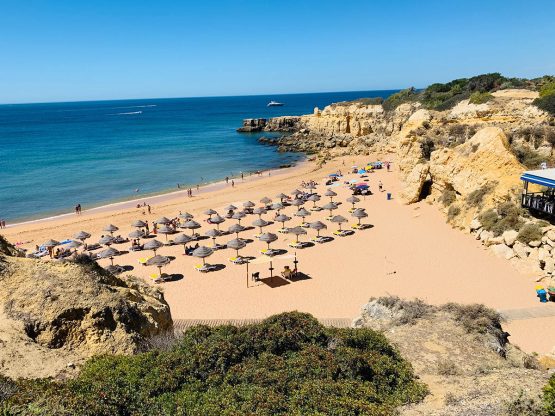
Albufeira’s amazing, pristine beach that stretches almost the full length of the town-centre is the major focus during the day. Stretched out on the sand or shaded by beach umbrellas, bathers while-away the lazy daytime hours, often returning to their hotels only for a sumptuous midday meal and a siesta. The beach is flanked on the one side

by sandstone cliffs that project a protective armout into the sea.  Above them, the town appears at first glance to be a jumble of stark white buildings clinging tenaciously to the hillside like coral.

In the casual atmosphere of Albufeira’s narrow streets, the white jumble resolves itself into individual buildings neatly painted in shades of white, grey, and terracotta. Boutiques and blue-and-white canopied shop-fronts invite shoppers to explore each wonderfully and individually paved street.

For other pleasure-seekers sightseeing, or a day-trip along the coast to one of the many little towns in the vicinity is an excellent option, or perhaps a hike and the discovery of a secluded cove. But once the sun sets on the Algarve, the real entertainment begins in Albufeira…

This is the Algarve’s major tourist centre where not much Portuguese is spoken locally,

but top-class hotels, restaurants, bars and sports bars abound. Music rings out across

the night from a host of different sources, calling revelers to new discoveries.  The Strip,

a 2 km avenue of clubs and bars is situated in the Montechoro area, about 3 km from

the centre of town. The bright neon lights draw the mostly youthful crowd like moths to

the abundant drinking spots and eateries on the Avenida Sá Carneiro. From there, the

partying and dancing continues into the early hours. From the rowdy and boisterous to

the mellow and romantic, there is something for everyone in Albufeira!

Pria da Rocha

The mild weather in the Algarve makes it a particularly good holiday destination for a large portion of the year. May to October are likely to be the best months for a visit. July and August are generally the hottest with temperatures of around 30 -35 degrees C January is cold and wet so not the best time of year for the holiday-maker.

Praia da Rocha is in competition with Albufeira with those almost endless beaches of sun-bleached sand nearly as broad as it is wide.  Then there are sparkling sands and aquamarine coves such as Ponta da Piedade where the ocean eddies and flows around fascinating rock formations. Take a boat cruise to the Benagil sea caves, or a sailing cruise along the stunning coastline.

If it’s nightlife you’re seeking though, Pria da Rocha boasts a wealth of restaurants catering to every taste. There are also world-class hotels,

swinging bars and clubs, and the Algarve Casino Hotel situated in the heart of the town.

Pria da Rocha

While Lagos has not succumbed to a massive influx of tourism, it is still a popular destination for those who enjoy a vibrant nightlife. The city is set like a jewel in the scenic beauty of the Western Algarve. On the east side of Lagos is the Meia Praia Beach, the largest sandy beach of the western Algarve, a four kilometer stretch of pristine sand. 

But your holiday would simply not be complete

without a coastal boat trip. The weathered cliffs of the Ponta da Piedade headland are the most spectacular natural feature of the Algarve. The constant wash of the sea has sculpted arches, caves, and hidden grottos, from the rock, and the surroundings cry out to be explored. 

Not to be missed are the scenic cove beaches of Praia da Dona Ana, and Praia do Camilo.

The pristine marina complex in Lagos has been designed to complement the local architecture while retaining a distinctly contemporary feel.You may not have a yacht anchored in the yacht basin, but you could have a meal in one of the marina’s many restaurants and luxuriate in the view.

Lagos retains its Portuguese character and a rich sense of its seafaring past. At the estuary, not far from the marina complex, lies the old fishing harbour with colourful fishing boats constantly pursued by a host of hopeful gulls.

Many of Lagos’ hotels and restaurants welcome families.  There are sheltered beaches supervised by lifeguards, theme parks, water parks, a local zoo, and boat trips from the harbour to watch the dolphins at play.  

Lagos is far less frenetic at night than Albufeira or Praia da Rocha and, as such, more suited to a family holiday. Take a week in Lagos to explore the city and visit some of the surrounding areas such as the towns of Portimão, Sagres, Silves, and Praia da Luz.

There is a charm to the city – a delicious sense of the traditional; cobbled streets, genuine Portuguese restaurants all set against the welcoming pleasure of the modern hotels and tourist attractions.

Categories
Cascais Portugal Uncategorised

Cascais, Portugal – A Fishing Town, Charming and Traditional

Cascais, Portugal – A Fishing Town, Charming and Traditional

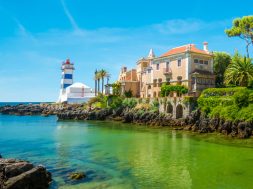
Photo courtesy of Julia Solonina upsplash.com

Along the northern side of the Tejo Estuary is the Linha de Cascais, an urban railway that takes you from Lisbon to the little fishing town of Cascais. The train departs from the Cais do Sodre train station in Lisbon and ends its short but delightfully scenic journey along the River Tagus, at Cascais station. The quickest and easiest method of travel from Lisbon is by train, particularly as the station in Cascais is located in the centre of town. Travel by car is easy but parking is limited. You also have the option of a somewhat slower bus-ride from Lisbon, but the bus terminal is not as conveniently situated as the station.

A notable landmark in Cascais is the Cidadela, a fortress built in the 15th century to defend the town against Spanish invaders.  Four hundred years later, King Luís I of the ruling House of Braganza visited this little fishing retreat, renovated the fortress and took up summer residence there. From then on, Cascais became one of the most sought-after and cosmopolitan holiday places in Portugal. Elegant villas with splendid views over the bay grace the coastline and fascinating museums face onto intricately cobbled streets.

Photo courtesy Liam Spradlin – upsplash.com

However, Cascais is still a fishing village. Fishermen push their boats off the beaches at sunrise and return with their catch of dorado, róbalo, sardines, octopus, crabs, and mussels; after which they gather hospitably around tables on the dock for a lunch of local wine, fresh bread, and fish soup served from enormous pots.

The town is charmingly set among the beaches of the Portuguese Riviera, from the relaxing swimming beaches of Cascais itself to the wide surfing beaches set against the dramatic natural scenery of the untamed Serra de Sintra in the north.

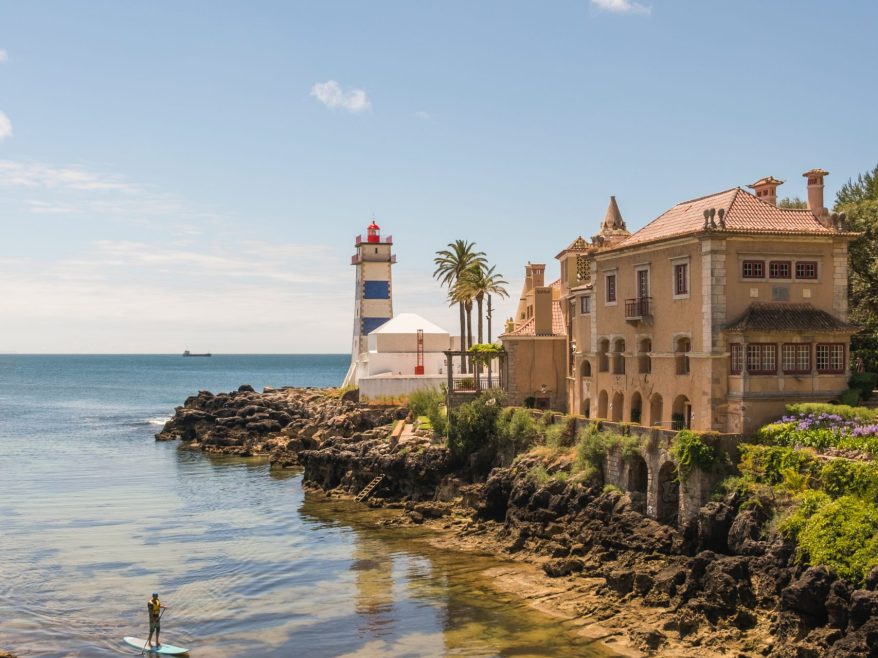
Day trips are available to Ericeira, Praia das Maçãs, and Sintra. Midway between Cascais and Sintra lies the rugged wind-swept headland of the Cabo de Roca. A lighthouse, cafe, and gift shop are the simple marks of civilisation in this wind-scoured meeting of land and surf. Mainland Europe terminates at the point where these wild cliffs jut out into the sea.

For those of us who prefer to avoid the well-trodden tourists haunts there are hiking trails following ancient paths along the cliff-tops. These lead to coves with unsullied beaches such as the Praia da Ursa or Praia da Adraga.

Cascais has a wonderful, moderate climate all year round with temperatures from 12 C to 25 C. Favorable sun and wind conditions make sailing, surfing, kite surfing, and windsurfing popular tourist activities in this region.

The Golden Visa program offers you much more than a brief holiday in this stunning area. Investing in property in Cascais and other parts of Portugal allows you a European Residence Permit Card and a Passport (Portugal) giving you the ability to live and travel all over Europe. Not only this but having an investor visa entitles you to live, travel, work or study in 26 EU Schengen Space countries. It is undoubtedly the opportunity of a lifetime.

Categories
News Porto Portugal

Porto – Portugal; Europe at its Best

Porto is a vibrant city, rich in history, boasting a wealth of tourist attractions, and a scintillating nightlife. It is rapidly becoming one of Western Europe’s most visited tourist destinations. Porto is the second-largest Portuguese city and a prime infrastructural hub, easily reached by different means of transport from the rest of the nation as well as from Europe.  However, despite remaining relevant to today’s world, Porto retains an integral link with its ancient past.

The Ribeira

Photographer – Michael Baccin

With its narrow cobbled streets and fascinating buildings, da Ribeira was not declared a World Heritage Site without good reason. It is the oldest district of the city, drawing the visitor into an era long past.  Clusters of colourful buildings line the Duoro River and the Ribeira square draws locals and tourists alike to its cafes and restaurants on the quayside. Built on the river mouth and with the salty smell of the sea in the air, the Ribeira is also a busy commercial area where fishmongers, grocers, bakeries and butcheries are interspersed with cobblers, bookshops and art studios.

Douro River

A boat tour is the best way to explore the scenic Douro River and there is a radically different way of viewing one of the river’s magnificent bridges – a real break-away from traditional sightseeing. Porto allows you the opportunity to climb the arches of the Arrábida Bridge. Participants are fitted with a harness and secure lifeline and attached by cable to the handrail. A guide leads you, via a narrow pedestrian stairway, up the ascent of the graceful arch of the bridge. At the peak, sixty-five meters above the Douro River you will be rewarded by panoramic views of the city and the river mouth.

Wine Tours and Wine Tasting

Photographer Nacho Dominguez

Further inland, the banks are lined with the cellars that produce and store Porto’s famous port wine. Wine tasting tours are immensely popular and a great draw to the tourist industry. Take a boat cruise up the Douro River where you will be offered wine-tasting opportunities and a typical Portuguese lunch. There are also half-day or full-day, scenic Douro Valley tours through the vineyards where you can visit the farms and cellars of the region. A visit to a traditional wine cellar will tell you more about the history, the harvesting and production of local wines and, no less important, you will discover how to identify the difference between Port families and learn to taste them like a professional!

Climate

Northern Portugal tends to be cooler and wetter than the southern region but Porto’s tourist season begins in May and continues until the end of October. To enjoy Porto’s unspoilt beaches, the peak season from June to the end of August, is generally hot and dry and most suitable for spending time on the beaches.

Porto for a Visit

You need at least a week to take in all the sites, smells, and sounds of this amazing city. On offer for the holiday-maker is a cross section of places to visit ranging from the colourful and the quaint, to the gold-plated splendour of the Baroque Church of São Francisco and the splendid pre-Romanesque Porto Cathedral. There are food and wine experiences to be had, great beaches and even a number of surfing spots. All in all, Porto is a city that may hook you in for a longer stay.

Real Estate Investment in Portugal

In 2012, Portugal streamlined the Non-Habitual Resident (NHR) Tax Regime with the intent of attracting non-resident citizens. To anyone wishing to set up residence in Portugal, this offers significant tax benefits.
All that is required to apply for the Non-Habitual Residence Tax Regime is that the applicant file a request stating that he or she had not resided in Portugal during the past 5 years. During the related year they must remain in Portugal for more than 183 consecutive or interpolated days or have housing that they intend to use as their habitual residence by December 31st of that year.

To Quote:

  • Exemption from taxation in Portugal, of foreign income, originated from dependent labour or pension income;
  • Taxation at 20% flat rate of proceeds from Portuguese origin, that result from added value activities.

Benefits under the Non-Habitual Tax Resident Regime are granted for a period of 10 years.

Categories
News Portugal

Lisbon is looking up

Lisbon is looking up

trams

BASED ON LISBON INSIGHTS 2019

BY OLIVER BANKS AND ALEX KOCH DEGOOREYND

KNIGHT FRANK’S PORTUGAL TEAM

Why is Lisbon currently in the spotlight?

In 2019, Lisbon was ranked the best city in Europe for investment and development prospects by PwC, up from 11th place in 2018. Solid economic fundamentals, affordable prices, a low cost of living and improving transport connections mean it is now an international destination for investors, developers and tourists alike. The city has also seen the arrival of a number of international developers in recent years which has boosted market sentiment.

What government incentives are appealing to overseas buyers?

Introduced in 2009, the government’s Non-Habitual Residency (NHR) initiative allows anyone who has not been resident in Portugal for the past five years to receive pension income, rental income, capital gains on real estate and non-Portuguese income tax-free. The NHR is valid for 10 years.

Although Golden Visas are common in a number of southern European economies, Portugal’s scheme, which started in 2012, has been one of the most popular. Since this time, over 7,291 residence permits have been granted to non-EU residents. There are different ways of obtaining residency, 6,879 opted to purchase real estate (via an investment of €500,000 or more), 397 transferred capital and 15 created a minimum of 10 jobs. The latest data shows Chinese, Brazilian and Turkish buyers have been the most active applicants.

It’s also worth noting there is currently no inheritance tax, gift tax or wealth tax in Portugal.

Cute restaurant

Portugal is safe, picturesque and offers new experiences around every corner.

Which areas are prime locations?

Built on seven hills, Lisbon offers a mix of neighbourhoods, each with a distinct feel. The Avenida da Liberdade is the central spine of the old town running down to Baixa, the historic quarter, providing easy access to theatres, restaurants and the waterfront. The upmarket district of Chiado, the city’s cultural heart has largely been rebuilt following a fire in 1988 and with prices now close to €10,000 per sqm the area generates some of the highest premiums in the city.

To the west sits Belém, a quieter district with a village-like feel, overlooked by the Ajuda National Palace. Once home to dockyards and warehouses the area now offers green space, parks and plazas.

The coastal town of Cascais, located 30 km to the west of Lisbon, is a second home retreat comprised of detached villas, world-class golf courses as well as good international schools.

Where is demand coming from?

International demand is strengthening with Brazilian, Turkish, French, English and Chinese buyers on the rise. Portuguese buyers are also active as domestic wealth is increasing. At 6.4%, unemployment is at a 17-year low and the Portuguese economy has exceeded the Eurozone’s average GDP for the last four years.

Tourism too is on the up with the number of international visitors to Lisbon reaching 4.5 million in 2018 providing a source of rental demand for those seeking an investment property. There is a noticeable lack of rental stock which is driving the investment sector with gross residential yields of around 6% achievable in the city centre and 8% in the city’s outskirts.

What investment is planned?

With three tech parks, 90 higher education institutions, two universities and a vibrant start-up scene, Lisbon is emerging as one of Europe’s creative hubs. To meet this demand, the city’s transport infrastructure is being upgraded. Due to open in 2022, the new Monitjo Airport will service 50 million passengers per annum, up from 28 million at present.

A €210 million Metro project is underway which will result in two new underground stops and the regeneration of Cais do Sodré, the city’s main transport hub for trains, the metro and ferries. A €210 million Metro project is underway which will result in two new underground stops and the regeneration of Cais do Sodré, the city’s main transport hub for trains, the metro and ferries.

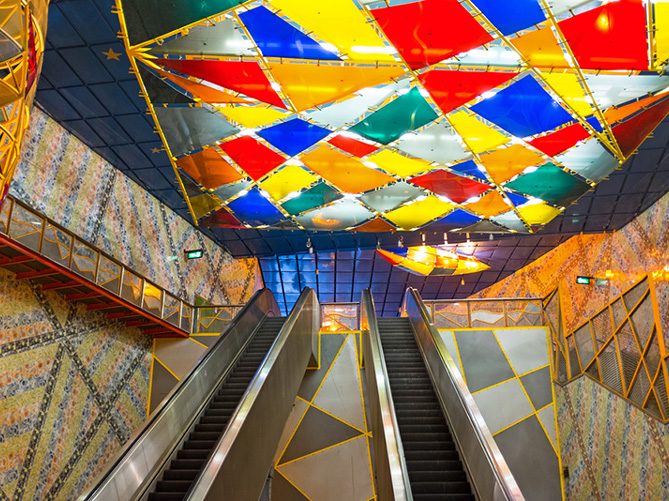
mosaic escalator

Lisbon’s underground is part clockwork, part work of art.

Portugal’s many benefits for investors

Portugal’s success is a credit to years of responsive policy making and the government’s commitment to sound fiscal management and a proactive approach to preventing social ills. Like any foreign investment, there are cultural and regulatory barriers to overcome, and having a partner on board to guide you across the way is essential.

Mygrate—simplifying investment

Mygrate’s reason for being is to assist South Africans and people from all nationalities to make investments in the EU with confidence and peace-of-mind. We do the diligence, you reap the benefits. If you’re considering a move, why not set up a Zoom meeting with Joanne to discuss the possibilities further? Citizenship by investment starts at €350,000 for investments in regeneration projects in older districts, and €500,000 for new builds.

cobble street

Portugal weathering the Covid crisis 

Lisbon’s property market shows signs of positive response to the COVID crisis.

trams

Lisbon is looking up 

In this post we explore the outstanding potential of Prata Riverside Village, combining waterfront tranquility with urban convenience.

lagoon

Europe’s Hottest Property Market Is Getting Too Hot for Some 

Based on the article Why Portugal is too hot for some by Henrique Almeida for Bloomberg Portugal is sticking with its golden visa program even though locals are being squeezed. Ana Guerreiro points across the street at a handful of housing projects in Lisbon’s up-and-coming riverside neighborhood of Marvila. It’s where she moved in with her mother last year […]